
The Montessori philosophy of education is designed to remove obstacles to the child’s strong desire for independence and to nurture in the child an intrinsic motivation to learn and grow.
Unlike other preschool environments, the Montessori environment is not one where children are confined to a rigid work-schedule where the work they will do is decided for them. The child is free to work with the educational materials presented to him/her by the teacher. Children can work individually or together. The Montessori classroom is a learning environment for each child, and not all children are expected to do the same thing at the same time.
Montessori classrooms are carefully calibrated to make use of children’s “Periods of Sensitivity.” Periods of sensitivity are the times when a child expresses an irresistible urge to acquire a particular knowledge or skill, or when the child is more open to a particular area of learning. In prepared classroom environments, there are many interesting materials on the shelves to meet children’s sensitivities and developmental needs. Every child has the freedom to work independently to pursue their particular interests and curiosities, as long as they respect the rights of other children. They grow to understand the importance of respecting their peers in a social community, and learn to handle all materials and supplies with care and respect.


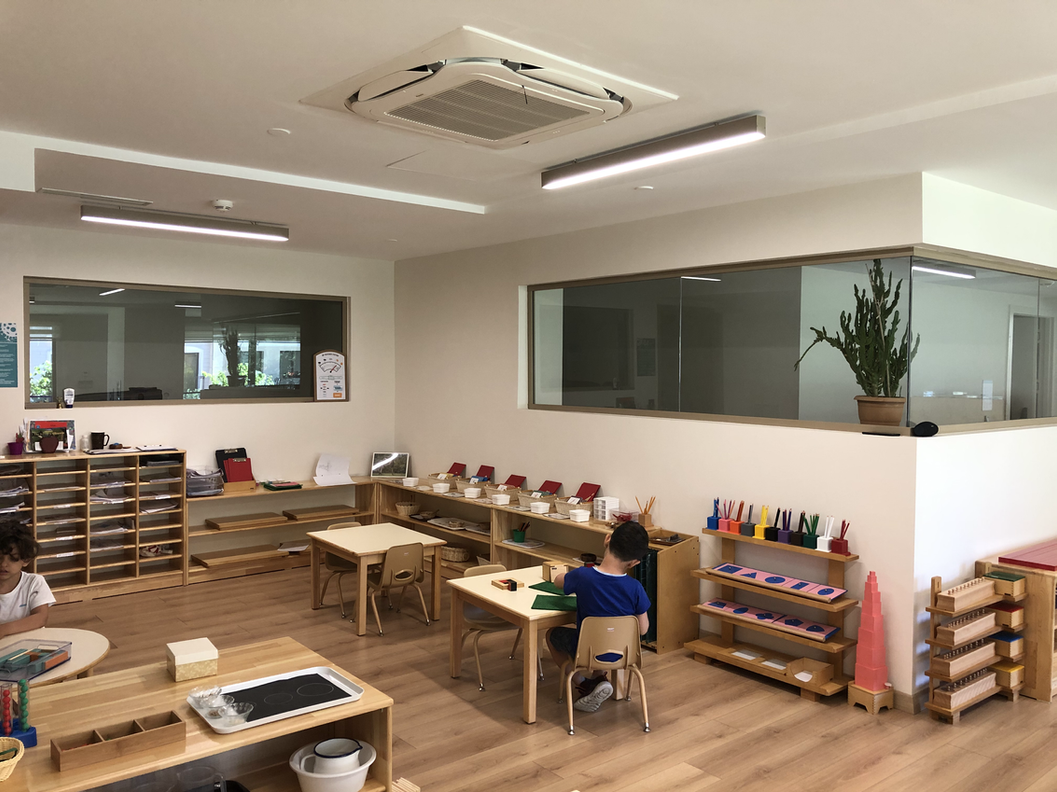
The Montessori guide acts as a guide and role model in the classroom. The guide observes the individual needs and interests of the children, shows the children how to use the materials and helps direct them to appropriate activities. Children are invited to participate in the presentation of materials but are not forced to participate in any way. The Montessori guide follows behind the child as he or she works and allows the child to explore on his or her own and find the joy of achievement.
The basic principles of the Montessori philosophy can be briefly summarized as follows:
I. Characteristics to be nurtured in the child:
-
Love of learning
-
Respect for themselves, others and their environment
-
Independence
-
Responsibility
-
Self-discipline and intrinsic motivation
-
Ability to concentrate
-
Ability to work alone and with others
II.Issues to be considered in approaching the child in Montessori classrooms:
-
Holistic approach to child development (social, emotional, physical, mental and spiritual)
-
Deep respect for the unique personalities of each child (sensitivity to diversity)
-
Mixed-age classrooms, designed with a three-year developmental cycle in mind, where children work in the same environment for three years
-
Children are encouraged to take responsibility in their classroom and community and to be helpful, respectful and peaceful
-
Recognizing that children have different interests, needs and abilities in the classroom
-
Striking a balance between group structure and individual freedoms in the classroom
-
Perceiving the classroom as a child-centered learning community
Working on one’s own and at one’s own pace, along with the free choice of materials, develops the child’s organizational skills. The child learns to plan, to prepare, to share, to get ideas, to compromise, to be harmonious, to work together with others, in short, to act in a unique, effective and purposeful way.
To summarize, the child who grows up according to the Montessori philosophy is a self-sufficient student at a very young age, who can concentrate on his/her work for a long time, who always works for a purpose, who repeats a work until he/she reaches the end goal, who has a high imagination and is a happy student.